

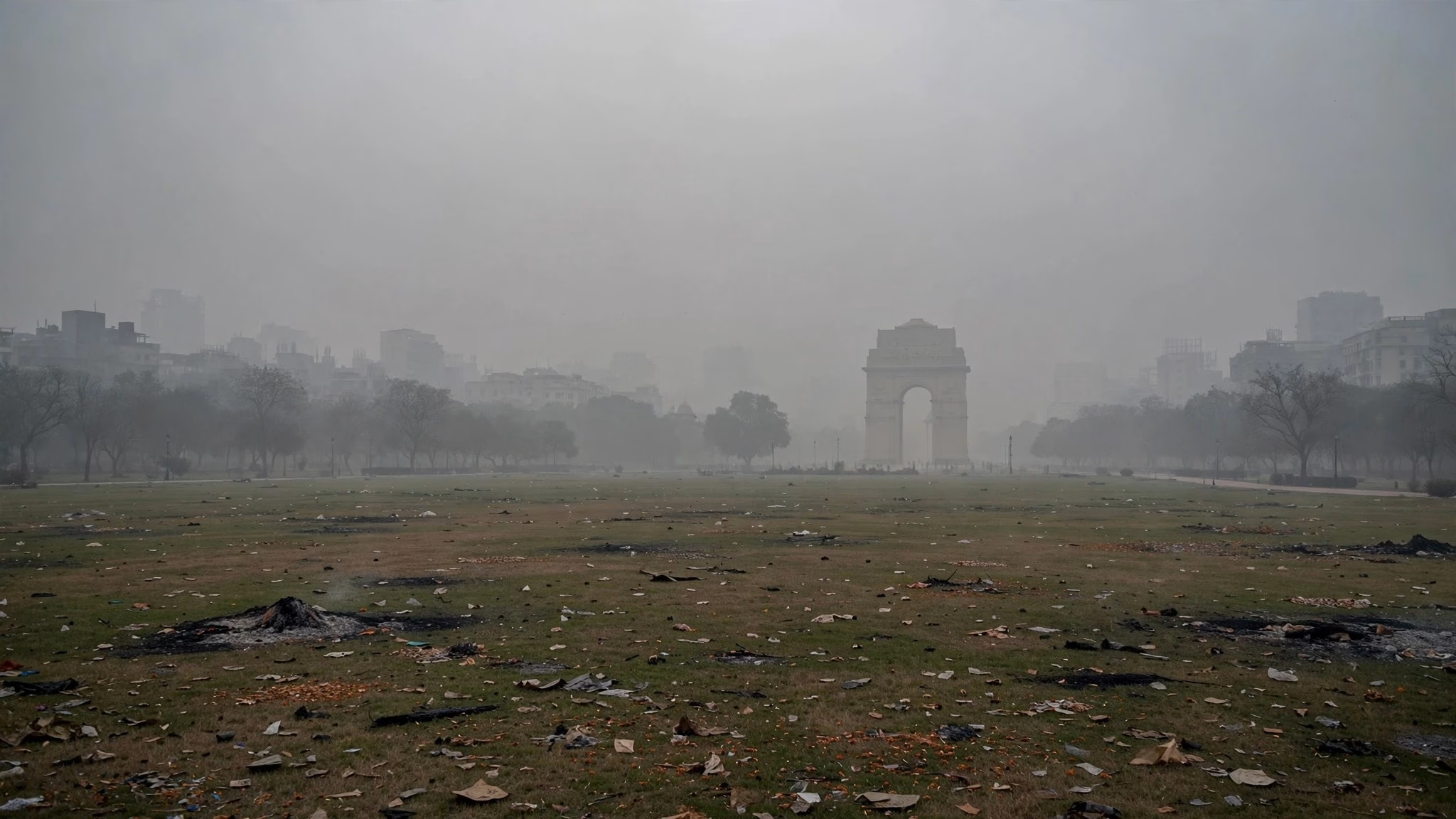
Delhi woke up on Monday to a thick blanket of smog as the air quality in the national capital deteriorated sharply after a night of Diwali firecrackers, with pollution levels in several parts of the city touching the severe category. The Central Pollution Control Board recorded an overall air quality index of 368 at 7 am, placing the city firmly in the very poor band, while several monitoring stations reported far worse readings.
According to reports, pollution in parts of the city shot past 50 times the World Health Organisation’s safe limit as people burst firecrackers well past the Supreme Court’s 10 pm deadline. The overall AQI had touched 384 on Diwali itself, and a Swiss air-quality monitor ranked Delhi as the world’s most polluted major city on the eve of the festival.
The morning smog cut visibility across the capital, slowing traffic on major roads and leaving a grey haze hanging over landmarks that are usually visible for miles. Residents stepped out to stinging eyes and scratchy throats, and many reached for masks that had been put away after the last pollution episode.
Doctors have advised people, particularly children, the elderly and those with asthma or other respiratory conditions, to stay indoors as far as possible and avoid morning walks until the air clears. Hospitals in the city traditionally see a spike in respiratory complaints in the days after Diwali, and this year is expected to be no different.
The spike is not the work of firecrackers alone. Every winter, Delhi’s air turns foul as cooler air traps pollutants close to the ground, and the festival this year coincided with that seasonal downturn. Smoke from farm fires in Punjab and Haryana, where the pollution control board has logged 3,144 stubble-burning cases so far this season, also drifts into the capital and adds to the load.
The Supreme Court had fixed a window for bursting firecrackers, but enforcement on the ground proved patchy, with bursts continuing well into the night in many neighbourhoods. Civic agencies say they will now step up measures under the graded response action plan, including checks on construction dust, curbs on polluting vehicles and a push to keep the city’s smog towers and sprinklers running.
For now, the capital’s residents face another familiar November ordeal: a sky that refuses to clear, an AQI board that stays stubbornly in the red, and a wait for wind or rain to do what regulation has not. The weather office has said conditions are unlikely to improve quickly, which means the smog could linger for several days.
Delhi’s post-Diwali air has become an annual reckoning, and this year the numbers are a reminder of how little has changed. Until the sources of pollution — firecrackers, farm fires, vehicles and dust — are tackled together, the morning after Diwali will keep looking the same: a city wrapped in grey, breathing air that is officially unsafe.
