

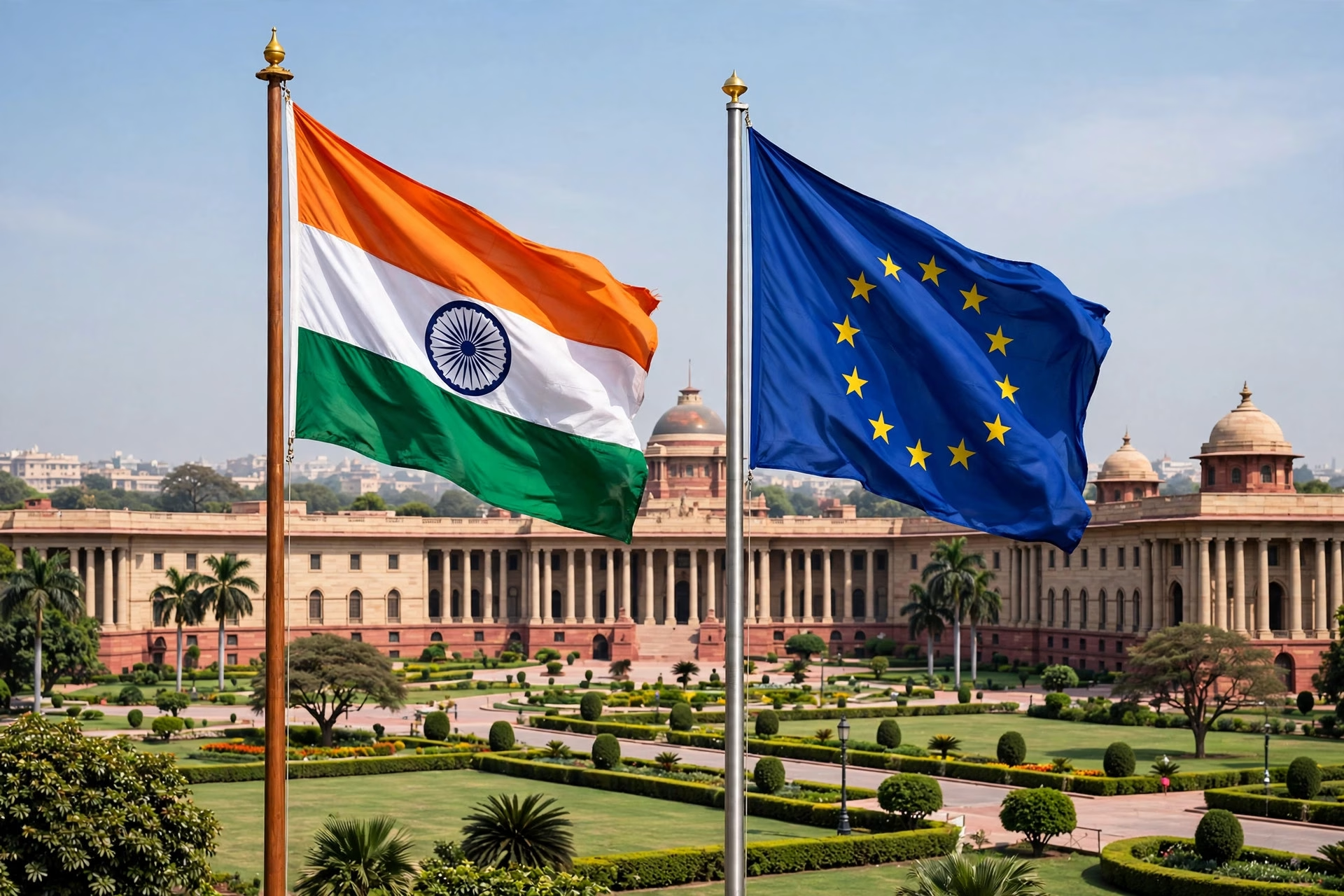
India and the European Union have reviewed the full spectrum of their strategic partnership, stepping up cooperation on trade, investment, emerging technologies and connectivity at a meeting in New Delhi on Monday.
The 7th India-EU Strategic Partnership Review Meeting was co-chaired by Sibi George, Secretary (West) at the Ministry of External Affairs, and Matti Maasikas, Deputy Secretary General for Geoeconomics and Interinstitutional Issues at the European External Action Service. The two sides took stock of progress in implementing the Joint Comprehensive Strategic Agenda that frames the relationship.
The agenda was broad, and deliberately so. Trade and investment topped the list, with both sides keen to deepen an economic relationship that has grown steadily but still has room to expand. Alongside it sat the technologies that will define the next decade: artificial intelligence, quantum technologies, advanced semiconductors, clean technology and biotechnology.
The meeting also addressed research cooperation, including India’s potential association with Horizon Europe, the EU’s flagship research and innovation programme. Association would give Indian researchers and institutions access to one of the world’s largest collaborative research frameworks — a significant step for a country that is investing heavily in science and technology.
Connectivity was another theme, reflecting the shared interest in resilient supply chains and secure trade routes. In a world where shipping lanes, undersea cables and critical minerals have all become strategic questions, India and the EU increasingly see each other as partners in building alternatives to fragile dependencies.
The review comes at a moment when both sides have reason to move closer. Europe is looking to diversify its economic partnerships, and India is looking for technology, investment and market access as it builds its manufacturing base. The strategic partnership, upgraded in recent years, is the framework within which that convergence is being organised.
Both sides expressed satisfaction with the depth of the engagement, according to the official account of the meeting. That is diplomatic language, but the breadth of the agenda — from semiconductors to biotechnology — suggests the relationship is no longer defined by trade alone.
The next test will be delivery: whether the discussions on trade, technology and research translate into agreements that businesses and researchers can actually use. For now, the review has done what such meetings are meant to do — confirm that the partnership is moving, and set the direction for the months ahead.
The review mechanism itself is part of the story. Regular strategic reviews give both sides a fixed point at which to measure progress and clear bottlenecks, and officials on both sides have said the format has helped keep a wide-ranging relationship on track even when individual negotiations move slowly. The seventh review continues that pattern, with working-level groups now expected to carry the detailed discussions forward.
