


Stockholm, Oct 8 — The Swedish Academy on Thursday awarded the 2026 Nobel Prize in Literature to Canadian poet, essayist and translator Anne Carson, honouring a career spent dissolving the boundaries between verse, prose, translation and scholarship. The 76-year-old was recognised “for her bold and inventive oeuvre that, in playful dialogue with the classical tradition, has created new forms for contemporary literature.”
The announcement, made in Stockholm, marks the fourth prize of this year’s Nobel season and carries a purse of 12 million Swedish crowns — about $1.2 million. Carson, who was born in Toronto and has held Icelandic citizenship since 2022, was reportedly in Iceland when the Academy’s call reached her. According to permanent secretary Ingrid Carlberg, the laureate was “very taken by surprise,” and was said to be “listening to the wind” when she received the news.
Carson had been a fixture of the Nobel conversation for years — bookmakers, including Ladbrokes, had installed her as this year’s favourite — and Thursday’s announcement closes one of literature’s longest-running speculation seasons.

Trained as a classicist, Carson built her reputation on dragging ancient Greek literature into restless conversation with the present. Her breakout work, Autobiography of Red (1998) — a verse novel that reimagines the myth of the monster Geryon as a contemporary coming-of-age story — announced a writer unwilling to observe genre boundaries. It was followed by The Beauty of the Husband (2001) and, in 2019, Norma Jeane Baker of Troy, a performance piece that braids Helen of Troy together with Marilyn Monroe.
The Academy noted that Carson has identified etymology — the hidden histories buried inside words — as the starting point of her work, a method visible in her celebrated translations of classical Greek, where linguistic precision meets poetic invention. Her writing moves between lyric poetry, essay, dialogue and translation, often within a single volume.
Carson’s win continues a Nobel season that opened with the Medicine prize on October 5 — awarded to Karl Deisseroth, Peter Hegemann and Georg Nagel for their work on optogenetics — followed by the Physics prize on October 6 to Francis Halzen for the IceCube Neutrino Observatory, and the Chemistry prize on October 7 to Henri Kagan and Kenso Soai for asymmetric organic synthesis. The Peace prize is announced on October 9, and the Economics prize on October 12.
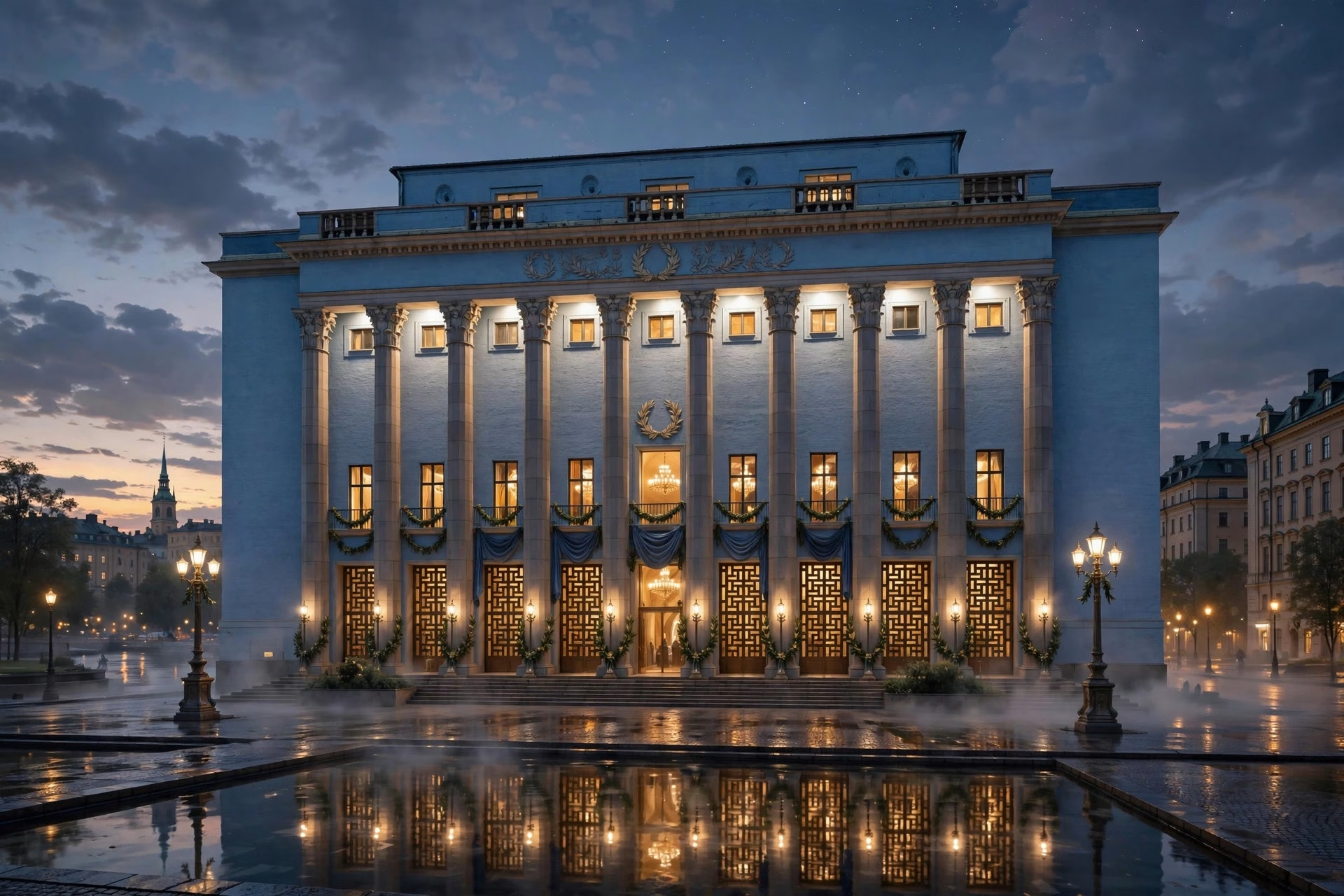
For readers new to Carson, the Academy’s choice is an invitation: to a body of work where a Greek myth can arrive wearing modern clothes, and where a dictionary entry can become a poem. As bookstores from Toronto to Reykjavik brace for a run on her backlist, the laureate herself — per the Academy — was simply listening to the wind.
