

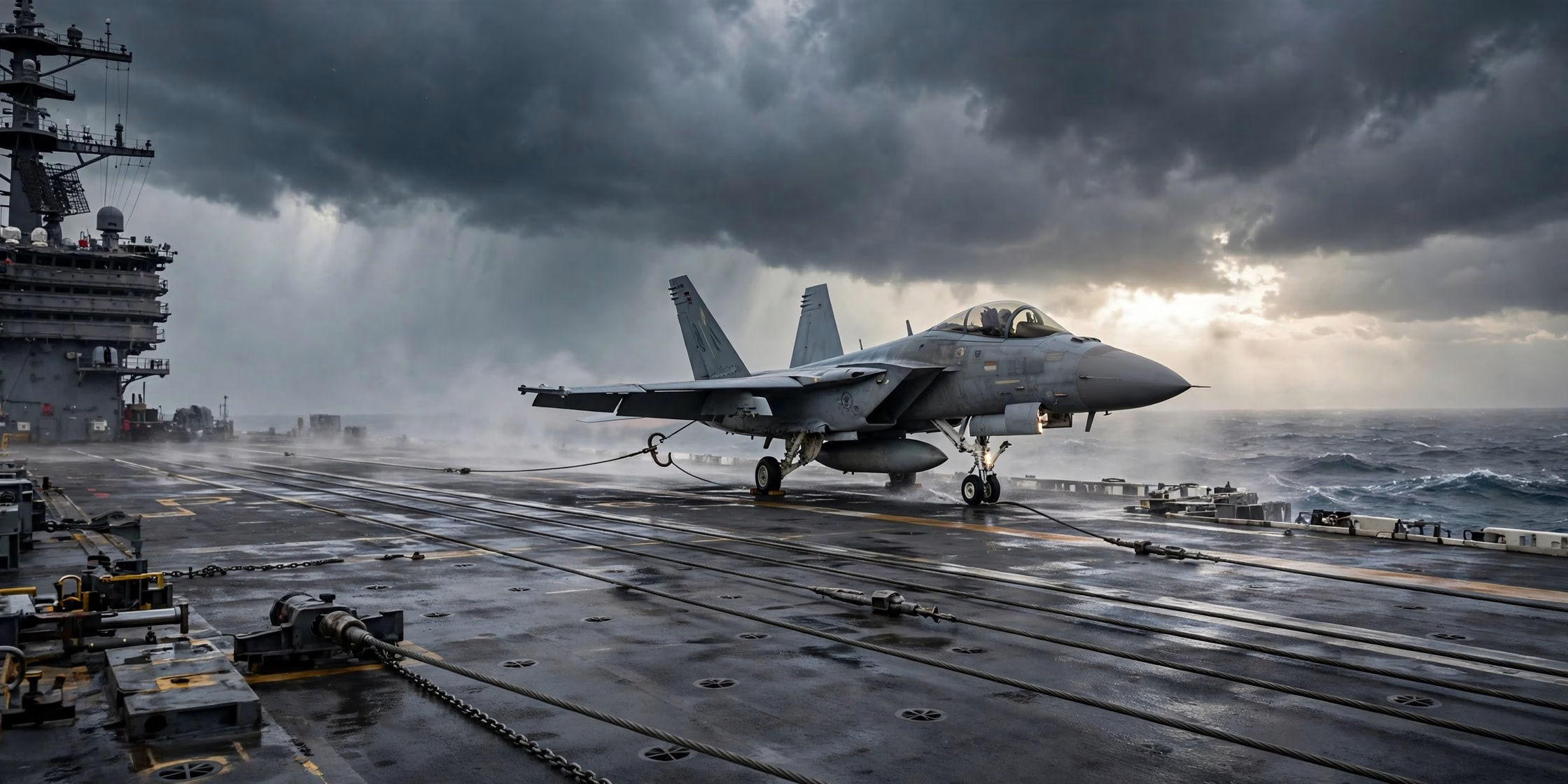
A Rafale Marine fighter aircraft has successfully landed on board the Indian Navy’s indigenous aircraft carrier INS Vikrant on its maiden attempt, the Navy confirmed on 30 October, marking a major milestone in integrating the French-built jet into India’s carrier fleet. The landing, carried out on 29 October, is the first step towards operationalising the aircraft in the Indian Navy.
“A Rafale Marine aircraft successfully landed onboard Indian Navy’s indigenous Aircraft Carrier INS Vikrant on its maiden attempt on 29 Oct 26. The ongoing trials mark the first steps towards operationalisation of the aircraft in the Indian Navy,” the Navy said in its statement. The landing was conducted under the command of Captain Ashok Rao, NM, Commanding Officer of INS Vikrant, and the Navy released video footage of the event.
The carrier landing followed shore-based trials at the Shore-Based Test Facility at INS Hansa in Goa, where a ski-jump ramp replicates the carrier’s deck. Those trials were designed to assess what changes, if any, were needed for the Rafale Marine to operate from Vikrant, and their success cleared the way for the shipboard attempt.
The technical challenge is real. The Rafale Marine was built for CATOBAR operations — catapult-assisted take-off but arrested recovery — as used by the French Navy’s carrier Charles de Gaulle. INS Vikrant, by contrast, uses STOBAR, short take-off but arrested recovery, in which aircraft launch from a ski-jump ramp and recover with arrester wires. Proving that a CATOBAR-designed jet can operate safely from a ski-jump carrier is exactly what these trials are for.
One practical issue under review is the Rafale Marine’s fixed, non-folding wing design, which affects how many aircraft can be parked and moved on a carrier deck. Carrier aviation is as much about deck management as flying, and the trials will examine handling, parking and turnaround alongside the headline landing itself.
The development is tied to India’s agreement with France, signed on 28 April 2025, for 26 Rafale Marine aircraft — 22 single-seat fighters and four twin-seat trainers — in a deal valued at approximately Rs 63,000 crore. Deliveries are expected to begin in 2028 and continue into the early 2030s, and the jets will mainly replace the Navy’s ageing MiG-29K fleet, which currently forms the core of Vikrant’s air wing.
INS Vikrant itself is a symbol of India’s shipbuilding ambitions. Built by Cochin Shipyard Limited and commissioned on 2 September 2022, the roughly 45,000-tonne carrier is the largest warship ever built in India. The Rafale Marine is now the third fixed-wing type to land on the ship, after the MiG-29K and the naval Light Combat Aircraft.
The Navy has been careful not to overstate the milestone. The announcement did not establish that the aircraft had completed all requirements for operational deployment, and the trials remain part of a broader process leading towards service entry. Carrier integration involves ski-jump launches, night operations, weapons trials and maintenance validation, all of which lie ahead.
Still, a first-attempt arrested landing is the kind of result that builds confidence. Carrier landings are among the most demanding manoeuvres in military aviation, and completing one on the first try, on a ship the aircraft was not originally designed for, is a strong early signal.
As the trials continue, the focus will shift from whether the Rafale Marine can land on Vikrant to how effectively it can fight from her. That answer will take years to complete, but this week, the Indian Navy took its first visible step towards it.
