

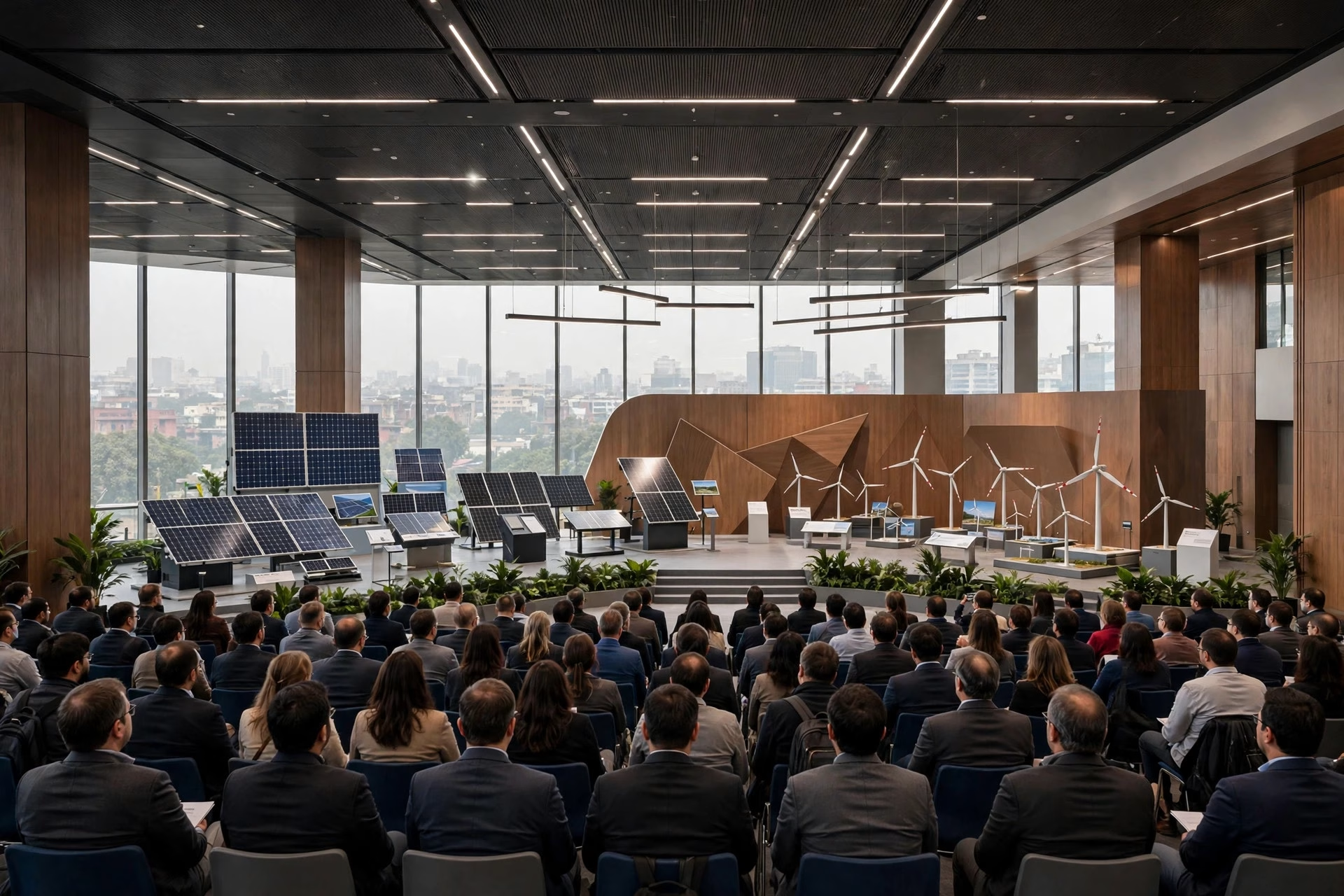
Prime Minister Narendra Modi on Monday inaugurated the Bharat Renewable Energy Summit and Expo (BRESE) 2026 at Bharat Mandapam in New Delhi, using the opening address to argue that energy security now depends on clean energy. India, he said, had met a major climate target five years ahead of schedule and was pressing on towards 500 GW of non-fossil fuel capacity, a goal that has become central to the country’s energy strategy.
The summit brings together policymakers, industry leaders, investors and technology providers at a moment when India’s renewable build-out is moving from ambition to scale. Solar parks, wind installations, green hydrogen projects and battery storage have all expanded rapidly in recent years, but the next phase — integrating that variable power into the grid, storing it affordably and using it to decarbonise industry and transport — is the harder engineering and financing challenge.
Modi’s message tied the energy transition to self-reliance. Clean energy, in his framing, is not only a climate obligation but a route to reducing dependence on imported fossil fuels, insulating the economy from volatile global oil and gas prices, and creating manufacturing jobs in solar modules, batteries and related equipment. The argument has gained force as India has scaled up domestic manufacturing alongside deployment.
The summit also showcased the human side of the transition. More than 21 lakh households have received zero electricity bills under the PM Surya Ghar rooftop solar scheme, according to figures cited in official updates this week — a reminder that for many families, renewable energy arrives not as a summit theme but as a rooftop panel and a smaller monthly bill.
There are, of course, hurdles that no summit speech can wave away. Land acquisition, grid connectivity, financing costs and the intermittency of solar and wind remain live constraints, and India’s coal fleet will continue to anchor base-load power for years. The credible test of the 500 GW ambition is not the target itself but the pace of project commissioning and grid investment in the next three to four years.
Still, the direction of travel is no longer in doubt. India is now among the world’s largest renewable energy markets, and the summit at Bharat Mandapam is designed to convert that scale into investment, partnerships and manufacturing deals. The Prime Minister’s opening pitch was, in essence, an invitation: the energy future is being built here, and it is open for business.
As delegates move from the inaugural session into exhibition halls and deal rooms, the measure of BRESE 2026 will be what it produces — signed projects, factory announcements and financing commitments — rather than what was said from the stage. On that score, the coming days will tell.
