

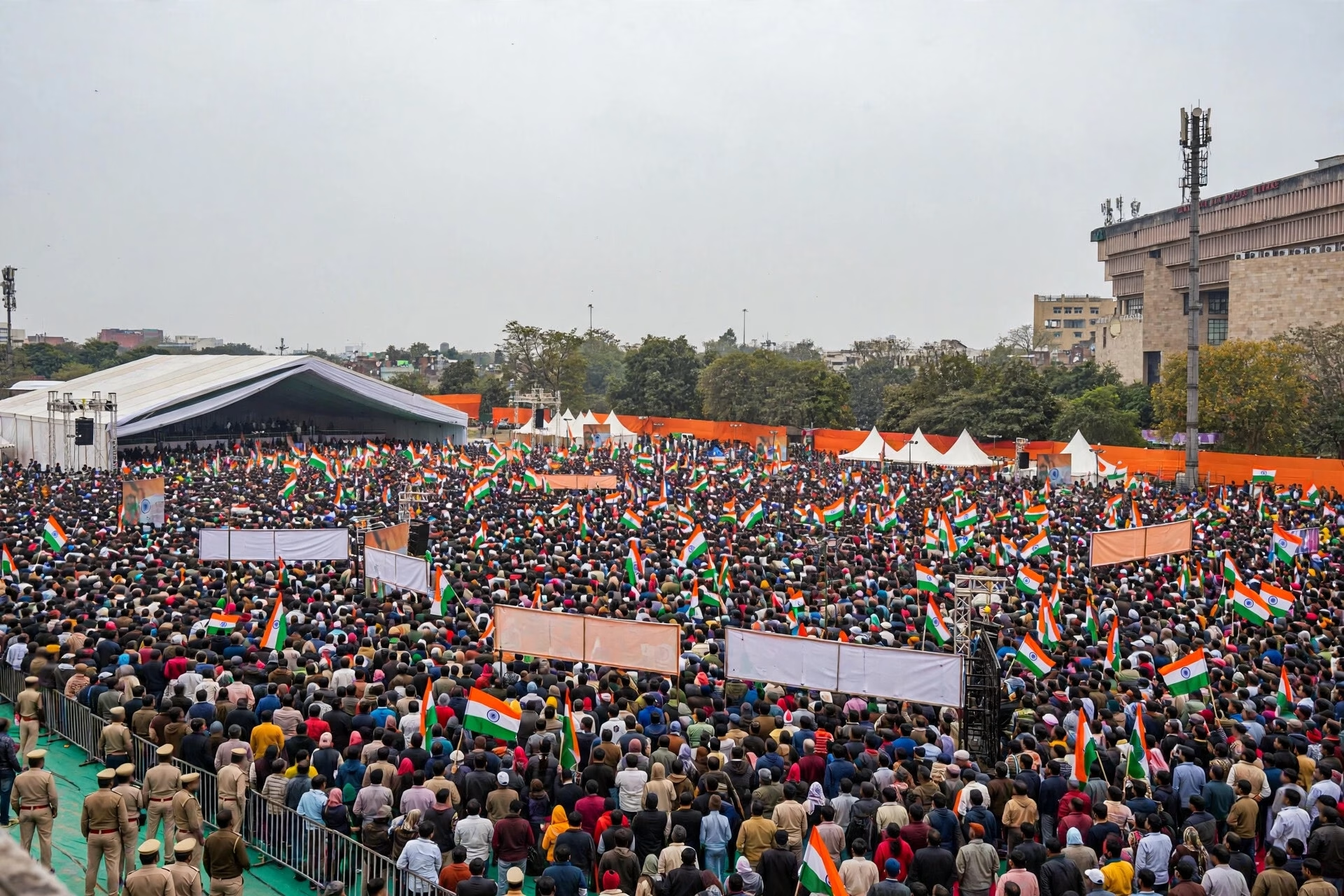
New Delhi’s Ramlila Maidan became the centre of opposition politics on Sunday, 1 November, as the INDIA bloc staged its ‘Chalo Dilli’ rally against alleged irregularities in the Special Intensive Revision (SIR) of electoral rolls and to demand the resignation of Chief Election Commissioner Gyanesh Kumar. Leaders, workers and student groups from across the country converged on the historic ground, turning the protest into one of the alliance’s largest mobilisations since its formation.
Congress general secretary (organisation) K.C. Venugopal framed the mobilisation as “Chalo Dilli, Vote Bachao, Desh Bachao” — Save the Vote, Save the Nation. He alleged that 13 crore names had been deleted from electoral rolls, describing it as a massive fraud unfolding state after state. The Election Commission has not publicly responded to that specific figure as attributed to Venugopal, and the Commission has previously rejected “vote theft” allegations as baseless.
Leader of the Opposition in the Lok Sabha, Rahul Gandhi, addressed the gathering and had earlier urged participants travelling to Delhi to support local traders during the festive season of Diwali, Chhath and Bhai Dooj. The appeal mattered because the rally fell in the peak pre-Diwali shopping week, when traders in Old and Central Delhi do some of their heaviest business of the year.
The rally’s three stated demands were clear: accountability over the SIR process, cancellation of the revision exercise as currently conducted, and the resignation of the Chief Election Commissioner. Some sections of the alliance have also pressed for a return to paper-ballot elections, a demand reported in coverage ahead of the rally. The SIR, an exercise to update and revise voter rolls, has been a flashpoint between the ruling coalition and opposition parties for weeks.
Delhi Police had granted conditional permission for the rally from 10 am to 5 pm, with organisers directed to use designated parking areas. Traffic movement in parts of Central Delhi was regulated and diversions were put in place during those hours, while a separate padyatra in West Delhi, from Hari Nagar DTC depot to Tilak Nagar Metro station, brought restrictions there from 9 am to 3 pm.
The timing drew a sharp response from the Chamber of Trade and Industry (CTI), which warned that barricading and crowd movement could force shop closures and put business worth more than Rs 10,000 crore at risk. CTI president Brijesh Goyal said the body had written three times to Rahul Gandhi and Congress president Mallikarjun Kharge seeking a postponement or a shift of venue, without a favourable response. On Saturday, traders put up posters outside shops in Kamla Market carrying the slogan urging that “shops of love” not be closed in “the market of politics”.
The traders’ body had suggested rescheduling the rally to after 10-11 November, or moving it to Burari Ground, which it said could park around 15,000 vehicles. Around 20 wholesale and retail markets within five kilometres of Ramlila Maidan — including Chandni Chowk, Sadar Bazar, Connaught Place, Khari Baoli, Bhagirath Palace, Chawri Bazar, Kashmere Gate, Karol Bagh and Daryaganj — were named in its assessment of areas at risk.
For the opposition, however, the rally was about scale and symbolism. Ramlila Maidan has hosted some of India’s most consequential protests, and the alliance chose it deliberately to project unity at a moment when electoral-roll revision is being contested in several states. The presence of chief ministers and senior leaders from multiple parties was intended to underline that the campaign is national, not confined to one state.
