

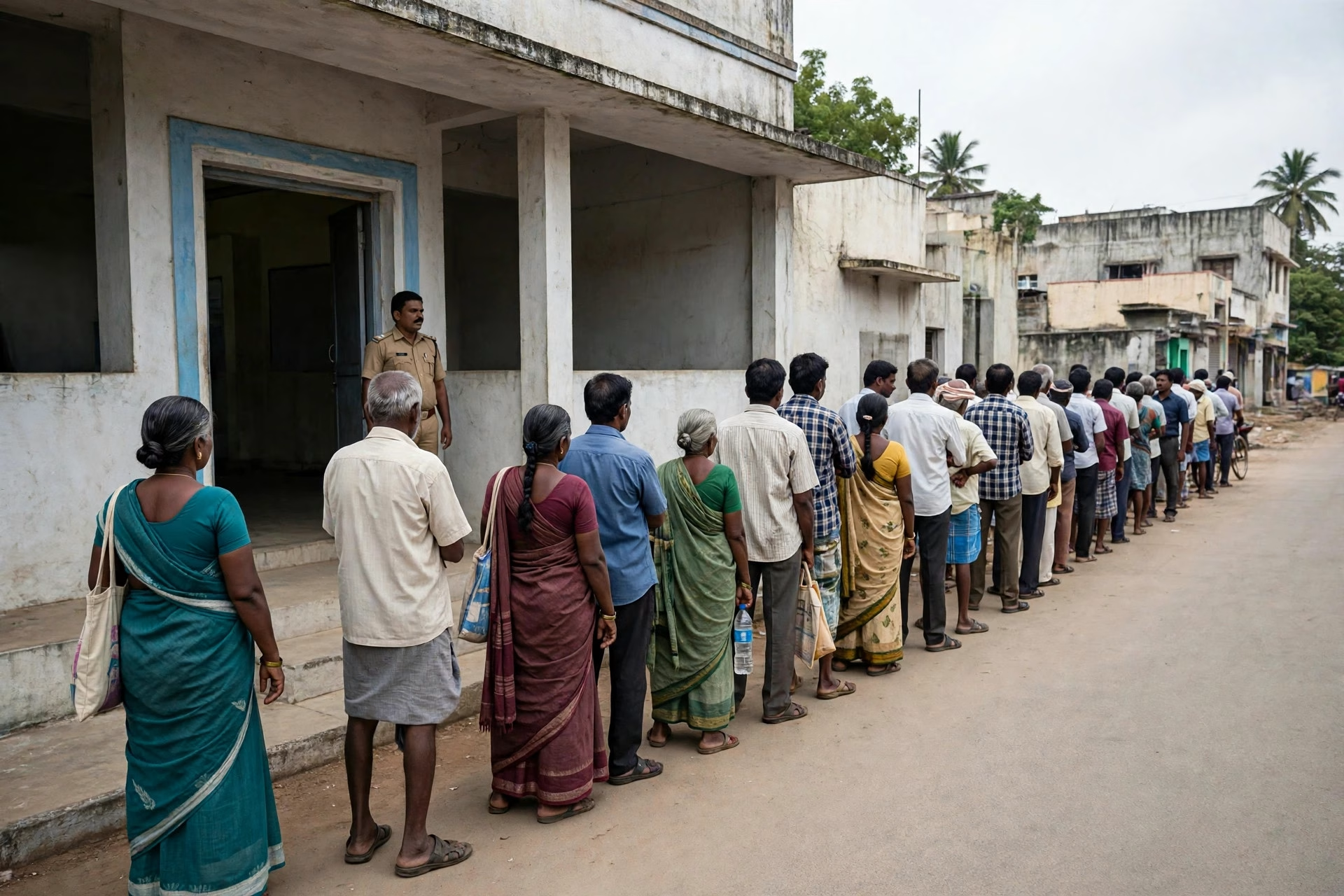
Voters across Andhra Pradesh headed to polling stations on Sunday, 1 November, for elections to 92 urban local bodies, in a contest rescheduled after Supreme Court directions and marked by a troubled nomination phase. Polling covers 13 municipal corporations and 79 municipalities and nagar panchayats, with counting scheduled for 3 November and repolling, if required, on 2 November.
State Election Commissioner Anil Chandra Punetha told reporters in Vijayawada on Saturday that the stage was set after days of hectic political activity and incidents of violence during the filing of nominations. Elections in eight municipalities and nagar panchayats — Allagadda, Dachepalli, Darsi, Gurajala, Kamalapuram, Piduguralla, Proddatur and Rayachoti — were unanimous, with chairpersons and councillors elected unopposed.
In the bodies going to polls, 118 of 922 corporation ward seats were elected unopposed, leaving ballots for the remaining 804 wards. A total of 3,073 candidates are in the fray for corporation wards, while polling in municipalities and nagar panchayats covers 2,382 wards with 6,669 candidates contesting. In all, 153 candidates are contesting for mayor in the corporations, and 367 applied for 70 chairperson posts in municipalities and nagar panchayats.
The election was originally scheduled for 28 October across 100 urban local bodies. The State Election Commission revised the timetable after the Supreme Court directed it to postpone publication of the final list of contesting candidates to 25 October and to consider representations — including from the YSR Congress Party and individual candidates — that some aspirants could not file nominations because of the law-and-order situation.
Fresh nominations were accepted for 48 hours in four civic bodies where complaints of violence and disruption came up during filing: Kadapa Municipal Corporation, Rajampet Municipality, Mydukur Municipality and Tirupati Municipal Corporation. Extra filing points were provided in those four bodies. Because of the extra time given there, polling in all 100 bodies was moved to the same day, 1 November, though eight bodies have since returned unanimous results.
Security arrangements are extensive. The commission has deployed 36,351 police personnel, working under 34 Superintendents of Police and 52 Additional Superintendents of Police. District-level plans illustrate the scale: in Palnadu district alone, officials set up 308 polling stations at 118 locations for four municipalities, deploying 1,840 personnel, with staff training completed in three phases and material distribution scheduled for 31 October.
Mayors and chairpersons in these elections are chosen directly by the people, following the Andhra Pradesh Municipal Laws (Fourth Amendment) Bill, 2026, passed in August. That change makes the top civic post a personal mandate rather than an indirect choice by councillors, raising the stakes for the leading parties in every town.
Public campaigning ended at 5 pm on 30 October. The immediate focus has now shifted from rallies to polling arrangements, voter slips and access to designated centres. Officials have urged voters to check their assigned station rather than relying on general announcements, since several polling stations may share a single physical location.
Counting on 3 November will settle who runs Andhra Pradesh’s towns and cities for the next term. Until then, party claims about momentum remain just that — claims. The results, when they come, will be read as an early signal of the state’s political mood ahead of bigger contests, and as a verdict on civic issues that matter most at street level: water, roads, sanitation and local taxes.
