

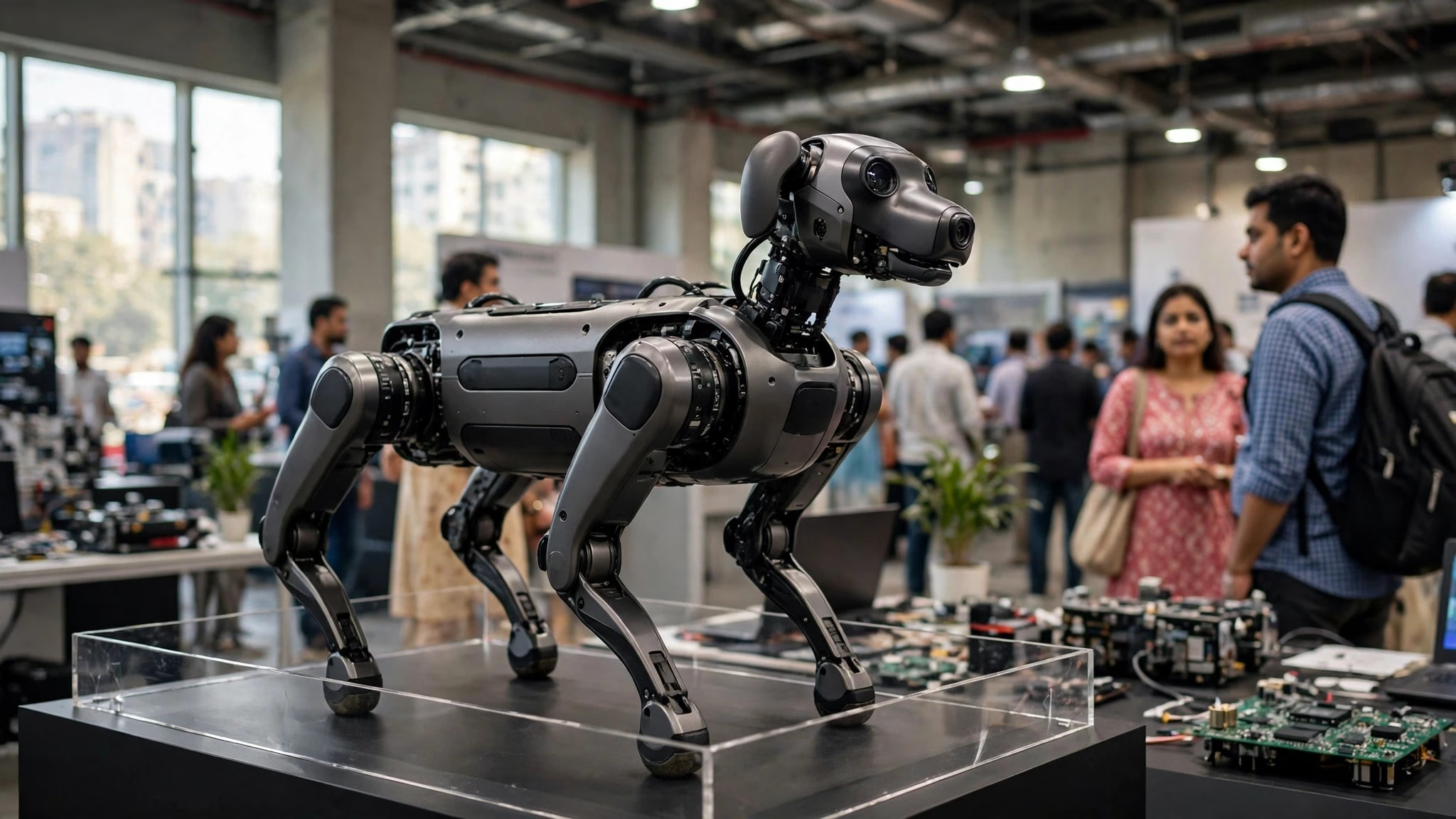
India’s flagship artificial intelligence showcase has been hit by an embarrassing episode after a robot dog presented as a university’s own research turned out to be a mass-produced machine bought from a Chinese company. The incident at the India AI Impact Summit in New Delhi has raised awkward questions about how exhibits at one of the country’s most high-profile technology events were vetted before they were put on display.
The episode centred on a four-legged robot dog named Orion, displayed at the exhibition stall of Galgotias University. Communications professor Neha Singh presented the machine to state broadcaster DD News as a development arising from the university’s own AI research programme, giving viewers the impression that it was the product of work carried out on campus. The segment was broadcast to a national audience, and for a short while the robot dog appeared to be a showcase of Indian academic innovation.
That impression did not last long. Viewers quickly identified the machine as the Unitree Go2, a four-legged robot dog made by Chinese company Unitree Robotics. The Go2 is widely available online, with prices generally quoted at roughly 1,600 to 2,800 dollars, and it is a familiar sight at technology exhibitions around the world. Once the identification spread on social media, the claim that Orion was a homegrown development collapsed.
Galgotias University was subsequently removed from the summit, a swift response that underlined how seriously the organisers took the episode. The university has not, in the verified reports of the incident, been shown to have offered a public explanation that changes the basic facts: a mass-produced robot was presented as the university’s own work, and it was recognised as such by members of the public rather than by the summit’s own checks.
The embarrassment is all the greater because of the scale of the event. The India AI Impact Summit is India’s flagship AI showcase, and it drew more than 20 world leaders alongside some of the most powerful figures in global technology, including Google chief executive Sundar Pichai and OpenAI’s Sam Altman. For an event designed to project India’s ambitions in artificial intelligence to the world, a mislabelled exhibit at a university stall was the wrong kind of headline.
Reports from the venue also described a series of organisational difficulties running alongside the main programme. Attendees reported Wi-Fi outages inside the conference centre, gridlocked traffic outside the venue, and some visitors said their belongings had been stolen. Taken together, the reports painted a picture of an event whose logistics struggled to match its ambitions, even as its main sessions drew global attention.
The robot dog episode, however, is the one that has travelled furthest, because it touches on a sensitive question for India’s technology sector. The country is investing heavily in artificial intelligence and is keen to be seen as a producer of original technology rather than simply a consumer of it. Presenting a bought-in product as indigenous research cuts against that ambition, and it invites scrutiny of the claims made by other exhibitors too.
For now, the episode stands as a cautionary tale about vetting. A flagship summit that brings together world leaders and the heads of the world’s biggest technology companies cannot afford to have its exhibits identified by viewers at home before its own organisers spot the problem. The question the summit’s organisers will now face is how a mass-produced robot dog, available to anyone with a credit card, was allowed to be presented as university research in the first place.
