

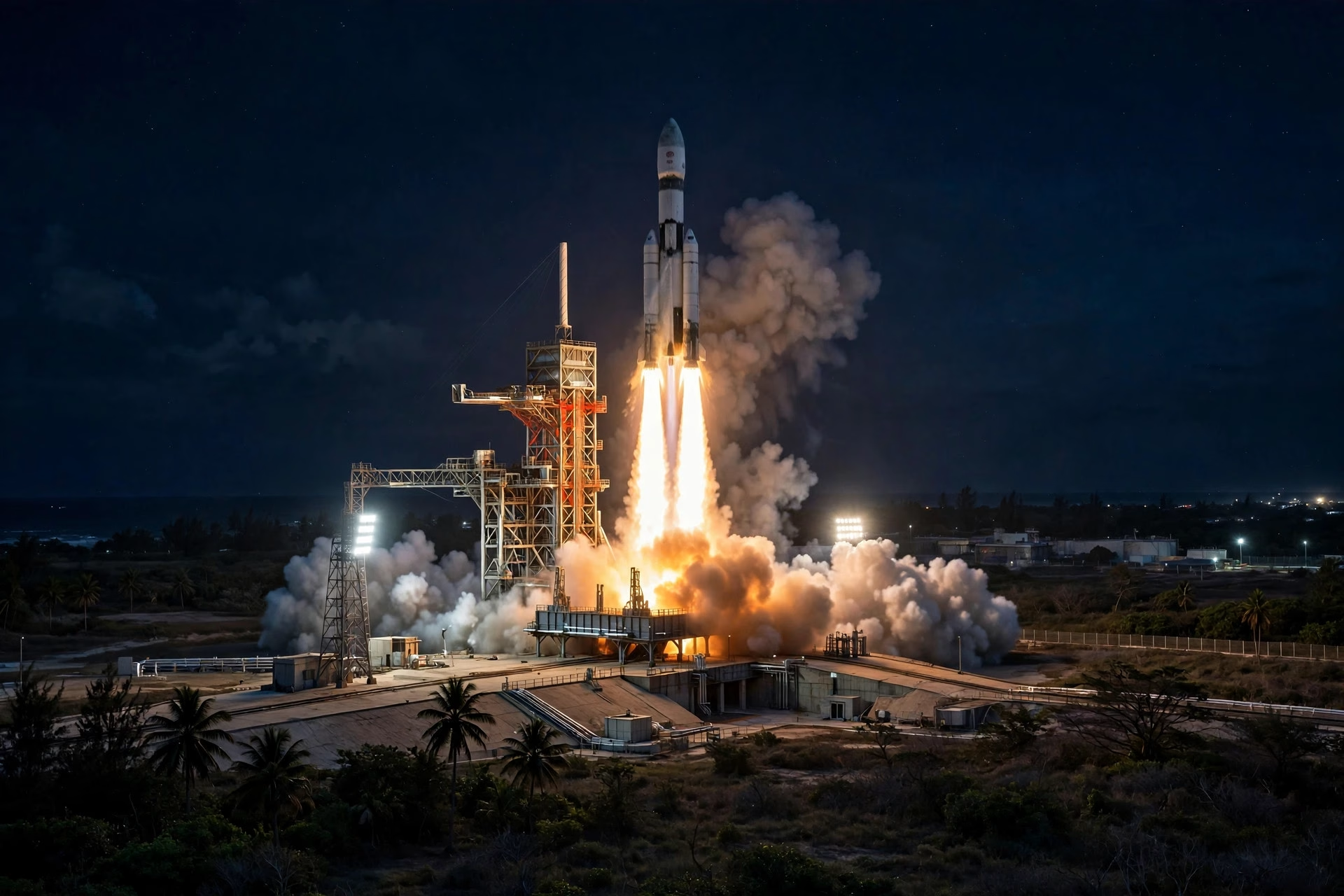
India’s newest navigation satellite is climbing steadily towards its operational orbit. The Indian Space Research Organisation (ISRO) reported on 31 October that NVS-03 had successfully completed its first orbit-raising burn, a day after the GSLV-F18 rocket placed it in its intended transfer orbit from Sriharikota.
GSLV-F18 lifted off at 11:51 pm IST on Friday, 30 October, from the Second Launch Pad at the Satish Dhawan Space Centre, Sriharikota. About 18 minutes later, the 2,250-kg satellite was placed into a geosynchronous transfer orbit of approximately 170.3 km by 38,080 km. At 12:23 am on 31 October, ISRO declared: “Mission Success! GSLV-F18 has successfully placed NVS-03 in the intended orbit.”
The first orbit-raising manoeuvre, performed on 31 October, fired the satellite’s liquid apogee motor for 2,174.8 seconds — about 36 minutes — raising its orbit to an estimated 5,477.6 km by 37,833.4 km. Further burns are planned to take NVS-03 to its final geosynchronous slot at 111.75 degrees east, after which in-orbit checks will precede its commissioning into navigation service.
NVS-03 is the third satellite in ISRO’s second-generation NVS series, built to sustain and upgrade NavIC — Navigation with Indian Constellation, India’s own regional satellite navigation system. The satellite carries an indigenously developed rubidium atomic clock alongside procured clocks, and transmits the L1 signal in addition to the L5 and S-band signals, improving accuracy for civilian users.
The mission carries particular significance because of what happened to its predecessor. NVS-02, launched earlier, was stranded by a propulsion-system problem, making NVS-03’s healthy progress a matter of close attention within ISRO. The space agency has been careful to distinguish between launch success and operational service: NVS-03 remains a spacecraft in deployment until its orbit-raising is complete and its navigation payloads are verified.
GSLV-F18 was the 20th flight of the Geosynchronous Satellite Launch Vehicle and ISRO’s second successful mission of 2026. Chairman V. Narayanan said after the launch that the NavIC constellation now has the minimum satellites needed to restore its services, and Prime Minister Narendra Modi congratulated the ISRO team on the achievement.
For users on the ground — from transport and logistics to disaster management and mobile navigation — the payoff comes when NVS-03 joins the operational constellation and begins broadcasting. That moment is still a few manoeuvres away, but the first burn’s success means the satellite is on its planned path, and India’s indigenous navigation system is a step closer to full strength.
The mission also reinforces a wider point about India’s space programme: self-reliance in navigation is not a luxury but a strategic necessity, and each successful NVS satellite reduces dependence on foreign constellations for services that millions of Indians now use every day.
