

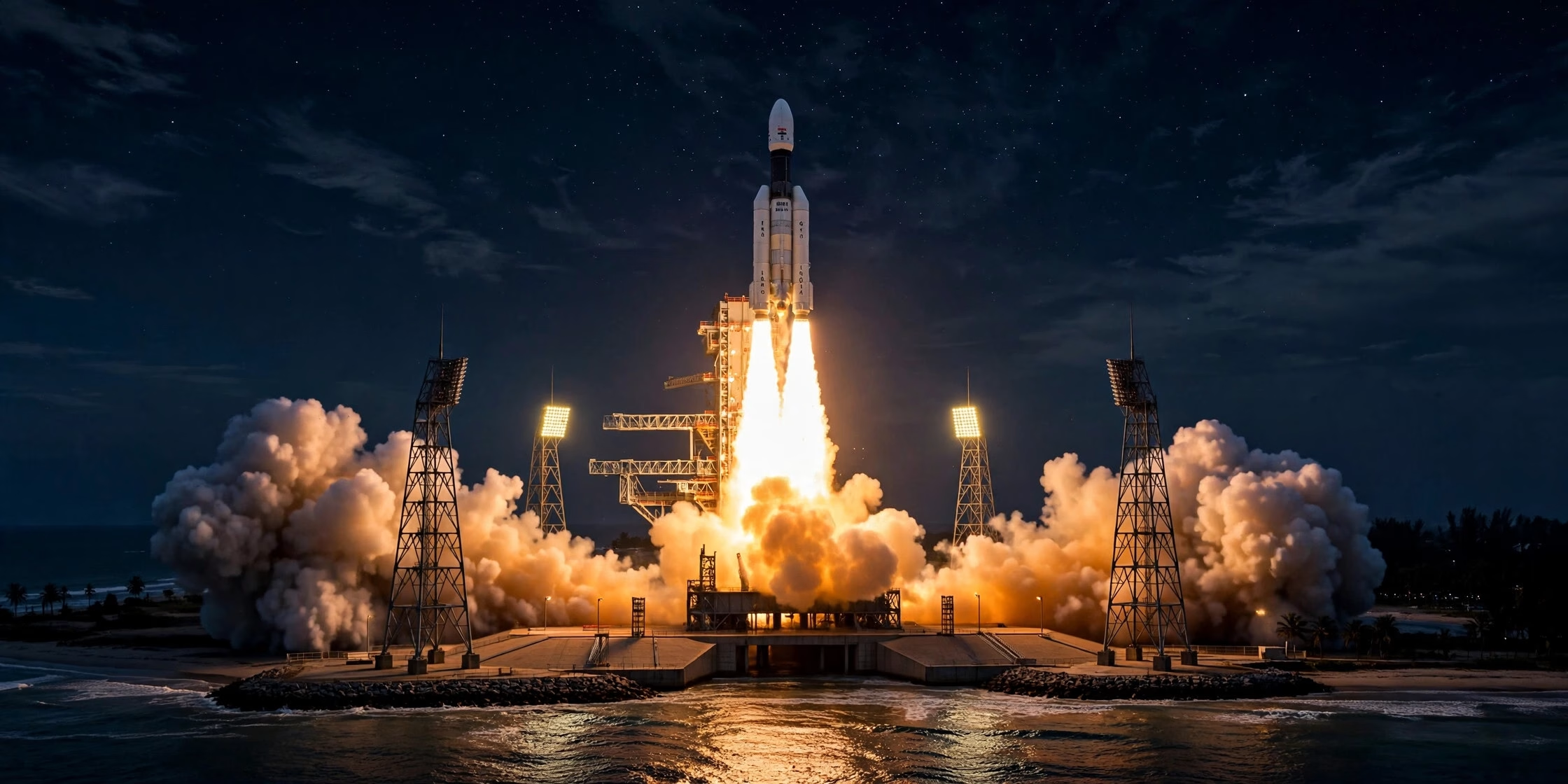
India’s navigation satellite programme took a decisive step forward in the early hours of Saturday, 31 October, as the Indian Space Research Organisation confirmed that its GSLV-F18 rocket had successfully placed the NVS-03 satellite in its intended orbit. The mission, which lifted off from Sriharikota at 11:51 pm on Friday, restored the country’s homegrown NavIC constellation to the four-satellite strength needed for basic standalone positioning services.
“Mission Success! GSLV-F18 has successfully placed NVS-03 in the intended orbit,” ISRO announced on X at 12:23 am, roughly half an hour after liftoff. The announcement closed the launch phase of the 20th flight of the Geosynchronous Satellite Launch Vehicle, a workhorse that has carried some of India’s most important payloads into space over the past two decades.
The roughly 50-metre, three-stage rocket lifted off from the Second Launch Pad at the Satish Dhawan Space Centre, SHAR, on the Andhra Pradesh coast, following a 24-hour countdown. It carried the 2,250-kg NVS-03 into a geosynchronous transfer orbit, an elongated stepping-stone orbit from which the satellite will now use its own propulsion system to climb to its final geosynchronous slot at 32.5 degrees East.
NVS-03 is the third satellite in ISRO’s second-generation NavIC series, built to keep India’s regional navigation service running as older spacecraft age. NavIC, or Navigation with Indian Constellation, provides positioning, navigation and timing services over India and the surrounding region, supporting everything from transport and logistics to agriculture, fisheries and disaster management.
ISRO Chairman V. Narayanan described the launch as highly precise and among the best performances achieved by the vehicle. He underlined that quality positioning services require a minimum of four satellites, a threshold India has now reached again, while uninterrupted, fully accurate service across the region needs seven. Two more satellites are nearing completion, and approval for another is under process.
The mission carried particular significance because of what went before it. Its predecessor, NVS-02, launched in January 2025, suffered a propulsion failure after a fuel valve problem prevented the satellite from reaching its intended orbit. Engineers spent the intervening months analysing the failure and redesigning systems, and NVS-03 flew with the lessons of that setback built into its configuration.
Mission director Thomas Kurian and his team also highlighted the pace of the campaign: a 47-day launch campaign and a 56-day gap since the previous GSLV flight, the shortest such interval so far, with the four L40 strap-on boosters prepared in a record 37 days.
What happens next is quieter but no less critical. Over the coming days, NVS-03 will raise its orbit, deploy its systems and undergo health checks before commissioning. Only after that process is complete will it begin contributing navigation signals to users on the ground.
For India, the stakes go beyond a single satellite. A robust, self-reliant navigation capability reduces dependence on foreign systems and underpins services that millions of people use without thinking about them: the location data in a phone, the tracking of a fishing boat returning to shore, the mapping of a field before sowing. Each satellite added to the constellation makes that capability harder to disrupt.
The success also sets up a busy period for ISRO. The agency has said it is targeting five more missions, including the uncrewed Gaganyaan test flight, as it builds towards human spaceflight. If NVS-03 completes its orbit-raising as planned, it will stand as evidence that the agency can absorb a failure, fix it, and return to flight stronger — the pattern on which its reputation has been built.
