

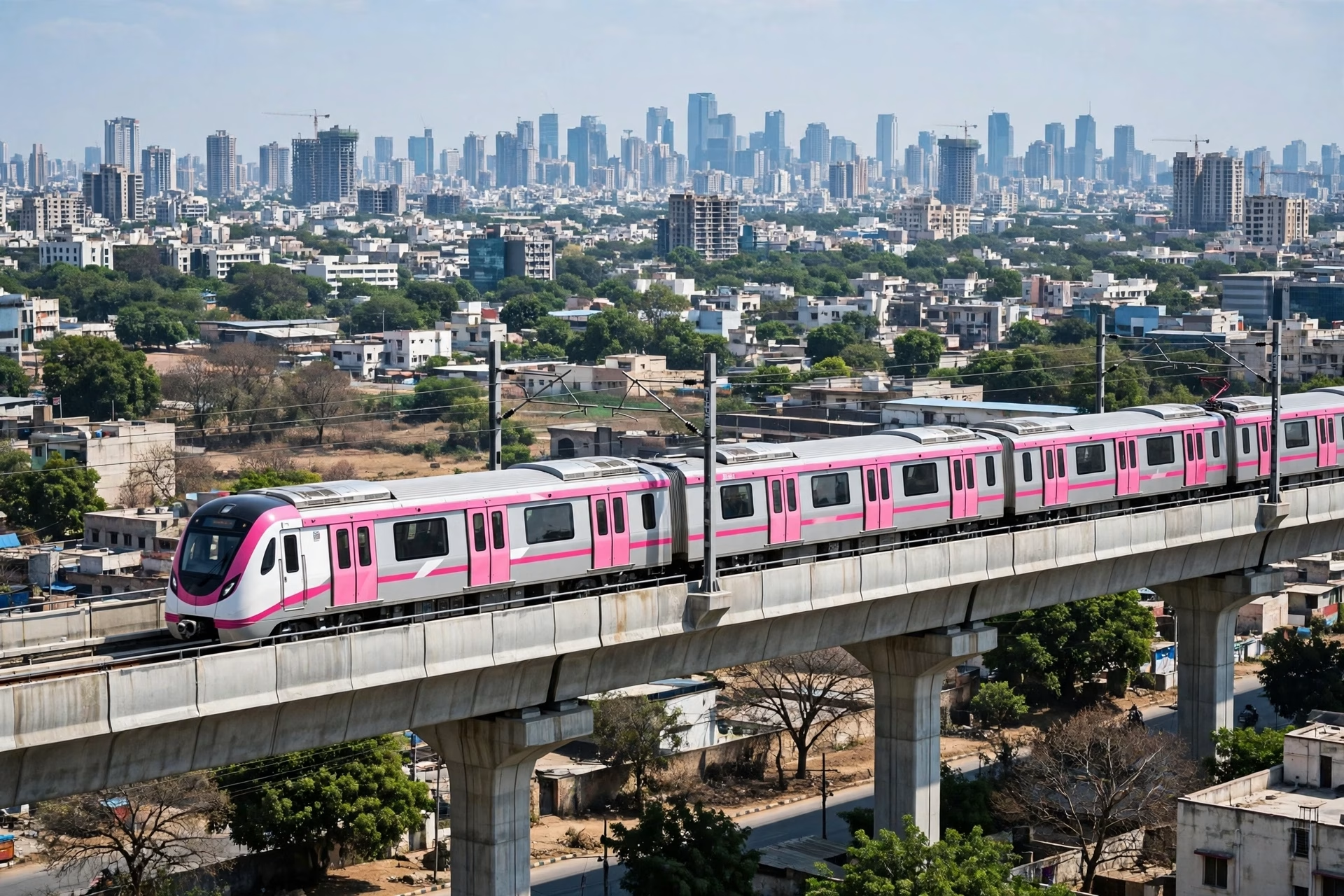
Prime Minister Narendra Modi on 4 November inaugurated the 23-kilometre Pune Metro Pink Line, also known as Line 3, via video conferencing, marking a major step forward for public transport in one of Maharashtra’s fastest-growing cities. The new line is expected to ease daily commuting in Pune, a city where rapid growth, expanding suburbs and rising traffic have put increasing pressure on roads.
Alongside the inauguration, the Prime Minister laid the foundation stone for four new metro corridors worth about Rs 21,800 crore. The new corridors signal that the expansion of Pune’s metro network is far from over, and that the city is being planned for the scale of growth it is expected to see in the years ahead. Taken together, the inauguration and the foundation-laying underline the central role that metro rail now plays in India’s urban transport strategy.
Addressing the occasion, Modi pointed to the scale of India’s metro expansion over the past decade. He said the country’s metro network has grown from 248 kilometres to 1,200 kilometres in 12 years, a transformation that reflects the pace at which cities across India have turned to mass rapid transit. That growth, he suggested, is not merely about kilometres of track but about changing how urban India travels, works and plans its cities.
Pune’s case illustrates why that expansion matters. The city has grown well beyond its old core, with information technology hubs, educational institutions, manufacturing zones and residential areas spreading outward. Roads alone have struggled to keep pace, and congestion has become a daily reality for commuters. A metro network offers an alternative that is faster during peak hours, less polluting and capable of carrying large numbers of passengers. The Pink Line adds a significant new stretch to that network, connecting more parts of the city to a modern transit system.
The foundation for four new corridors worth about Rs 21,800 crore points to the longer-term vision for Pune. New corridors are not built overnight, and their planning, construction and eventual opening will unfold over several years. But the decision to lay their foundation now signals a commitment to building transport infrastructure ahead of demand, rather than waiting for congestion to worsen. For residents, businesses and students who depend on the city’s transport system, that forward planning is as important as any single line opening.
Metro rail has become a defining feature of urban development in India over the past decade, and the figures cited by the Prime Minister capture that shift. From a network of 248 kilometres, India now has 1,200 kilometres of metro lines in operation, with more under construction in cities across the country. Each new line carries lessons about construction, financing and operations, and each city that joins the network adds to a growing body of experience in running large urban transit systems.
For Pune, the Pink Line inauguration is both a milestone and a starting point. The immediate benefit will be felt by commuters who gain a new travel option, but the larger significance lies in the network that is now taking shape around it. As the four new corridors move from foundation to construction and eventually to service, Pune’s metro system will grow into a more complete network, capable of serving a larger share of the city’s journeys. The inauguration on 4 November, conducted via video conferencing, thus marks not just the opening of a 23-kilometre line but another step in the steady expansion of metro rail as the backbone of urban transport in India.
